
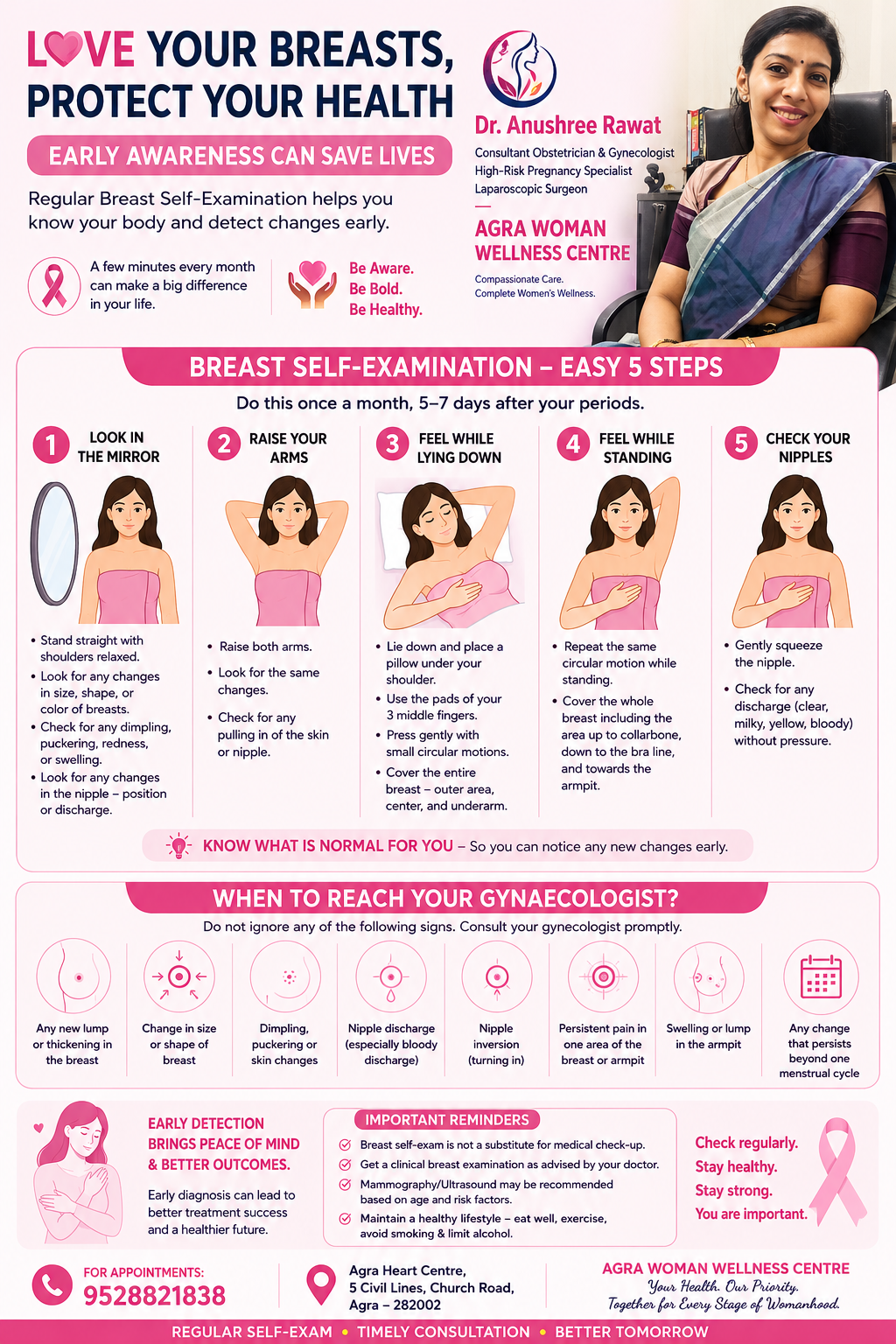
Lump in Breast: What Next to Be Done?
Breast Lump in Hindi & English | When to See a Doctor, Tests, Treatment & Warning Signs
A breast lump does not always mean breast cancer. But every new or unexplained breast lump deserves proper medical evaluation.
Finding a lump in your breast can immediately create fear and anxiety. Many women start searching online for “breast lump treatment in Agra,” “breast lump doctor near me,” “breast cancer symptoms,” “fibroadenoma treatment,” or “best gynecologist for breast problems in Agra.”
The good news is that many breast lumps are benign (non-cancerous). However, it is important not to diagnose a lump yourself. A clinical examination and, when appropriate, breast imaging and tissue testing can determine what the lump actually is.
At Agra Woman Wellness Centre, Dr. Anushree Rawat, Consultant Obstetrician & Gynecologist, High-Risk Pregnancy Specialist and Laparoscopic Surgeon, provides comprehensive women's health evaluation and guides women regarding appropriate breast-lump assessment and referral when required.
स्तन में गांठ: अब क्या करें?
स्तन में गांठ महसूस होना किसी भी महिला के लिए चिंता का कारण बन सकता है। लेकिन हर breast lump कैंसर नहीं होता।
स्तन में गांठ के कई कारण हो सकते हैं, जैसे:
- Fibroadenoma
- Breast cyst
- Hormonal changes
- Fibrocystic breast changes
- Infection or breast abscess
- Trauma-related changes
- Lactation-related conditions
- कुछ मामलों में breast cancer
इसलिए केवल गांठ को छूकर यह तय करना संभव नहीं है कि वह सामान्य है या गंभीर।
सबसे सही कदम है: घबराएं नहीं, लेकिन गांठ को नजरअंदाज भी न करें।
What Should You Do If You Find a Breast Lump?
Step 1: Don't panic
A breast lump is not automatically cancer. Several common benign breast conditions can cause lumps.
Step 2: Arrange a medical consultation
If you notice a new lump, especially one that persists, grows or is associated with other breast changes, consult a qualified doctor.
A doctor may ask about:
- Your age
- How long you have noticed the lump
- Whether it changes during your menstrual cycle
- Breast pain or tenderness
- Previous breast problems
- Pregnancy or breastfeeding status
- Family history of breast or ovarian cancer
- Previous breast imaging or procedures
Step 3: Clinical breast examination
Your doctor will examine both breasts and the areas around the armpits.
The examination helps assess:
- Size of the lump
- Location
- Shape
- Mobility
- Tenderness
- Skin changes
- Nipple changes
- Enlarged lymph nodes
Step 4: Appropriate breast imaging
Depending on your age, symptoms and examination findings, your doctor may recommend:
- Breast ultrasound
- Diagnostic mammography
- Sometimes both
- Further imaging in selected situations
For younger women, ultrasound is often an important first imaging test for a palpable lump. In older women, diagnostic mammography may be appropriate, often alongside ultrasound.
The exact test should be decided by your treating doctor rather than by internet searches alone.
When Is a Breast Ultrasound Recommended?
A breast ultrasound uses sound waves to examine breast tissue.
It can help determine whether a lump is:
- Solid
- Fluid-filled
- Cystic
- Suspicious
- Likely benign
Ultrasound is particularly useful for evaluating palpable breast lumps in younger women and for distinguishing cystic from solid lesions.
When Is Mammography Recommended?
A mammogram is an X-ray examination of the breast.
It can help detect:
- Abnormal masses
- Architectural distortion
- Calcifications
- Other suspicious breast changes
For a woman who has a new breast lump, the doctor may recommend diagnostic mammography depending on age and clinical findings.
A mammogram is different from routine screening. If you already have a symptom such as a lump, your doctor may recommend diagnostic breast imaging rather than simply waiting for a routine screening appointment.
Does Every Breast Lump Need a Biopsy?
No.
Some lumps have typical benign features on examination and imaging and may simply require follow-up.
However, if the examination or imaging shows a suspicious abnormality, your doctor may recommend a biopsy.
A biopsy involves taking a small tissue sample from the abnormal area so that it can be examined under a microscope.
One commonly used technique is core needle biopsy.
A biopsy does not mean that you have cancer. It means that the doctor needs tissue information to establish an accurate diagnosis.
Common Causes of Breast Lumps
1. Fibroadenoma
Fibroadenomas are common benign breast lumps, particularly in younger women.
They are often:
- Firm
- Smooth
- Mobile
- Painless
Some fibroadenomas only require observation, while others may need further evaluation or treatment depending on their size, symptoms and imaging characteristics.
2. Breast Cyst
A breast cyst is a fluid-filled sac within the breast.
It may become tender or more noticeable around menstruation.
Ultrasound can be particularly useful in identifying cystic lesions.
3. Fibrocystic Breast Changes
Hormonal fluctuations can cause breast tenderness, nodularity or lumpiness.
Symptoms may vary during the menstrual cycle.
Even when the pattern appears hormonal, a new persistent lump should still be assessed.
4. Breast Infection or Abscess
Breast infection may cause:
- Pain
- Redness
- Warmth
- Swelling
- Fever
- Tender lump
This is especially relevant during breastfeeding, although breast infections can occur in other situations as well.
Prompt medical assessment is important if infection is suspected.
Breast Lump During Pregnancy or Breastfeeding
Breast tissue changes considerably during pregnancy and breastfeeding.
Women may notice:
- Increased breast fullness
- Tenderness
- Engorgement
- Milk-filled areas
- Blocked ducts
- Mastitis
- Other palpable lumps
However, pregnancy or breastfeeding should not automatically be assumed to explain a persistent lump.
If a lump remains, grows or is associated with concerning changes, seek medical evaluation. Breast imaging can be performed when clinically indicated during pregnancy or breastfeeding.
Breast Lump: Warning Signs You Should Not Ignore
Seek medical evaluation promptly if you notice:
- A new lump that persists
- A lump that is increasing in size
- A hard or irregular lump
- A lump that feels fixed to surrounding tissue
- Bloody or unusual nipple discharge
- New nipple inversion
- Skin dimpling or puckering
- Skin thickening or an unusual change in breast appearance
- Persistent localized breast swelling
- Enlarged lymph nodes in the armpit
- A breast lump associated with unexplained changes in the breast
These signs do not automatically mean cancer, but they should not be ignored.
Is a Painful Breast Lump Cancer?
Pain alone cannot determine whether a lump is cancerous.
Many benign breast conditions can cause painful or tender lumps. Some breast cancers can also be painless.
Therefore, pain or absence of pain should not be used as a self-diagnostic test.
If you have a new or persistent breast lump, get it examined.
Can a Breast Lump Disappear on Its Own?
Some breast changes related to hormonal fluctuations may become less noticeable after menstruation.
However, if you have discovered a new lump, do not repeatedly postpone consultation hoping that it will disappear.
Your doctor can determine whether observation is appropriate or whether imaging is needed.
Breast Cancer: Why Early Evaluation Matters
Breast cancer is one of the important health concerns affecting women worldwide.
Early detection can allow appropriate treatment to begin sooner.
But an important message for every woman is:
A breast lump is a symptom that needs evaluation, not a diagnosis of cancer.
The correct approach is examination → appropriate imaging → biopsy when indicated → diagnosis → treatment plan.
Breast Lump Evaluation in Agra
If you are searching for:
- Breast lump doctor in Agra
- Breast lump treatment in Agra
- Gynecologist in Agra for breast lump
- Breast cancer screening in Agra
- Fibroadenoma doctor in Agra
- Breast cyst treatment in Agra
- Breast examination for women in Agra
- Breast ultrasound guidance in Agra
- Breast problem specialist in Agra
- Women’s health doctor in Agra
it is important to choose a qualified medical professional who can assess your symptoms and guide you toward the appropriate investigation.
Dr. Anushree Rawat at Agra Woman Wellness Centre provides women's health consultations and can evaluate breast-related concerns and guide patients regarding appropriate investigations and specialist referral when required.
Breast Lump: Frequently Asked Questions
क्या स्तन में हर गांठ कैंसर होती है?
नहीं। कई breast lumps benign होते हैं, जैसे fibroadenoma, cyst और fibrocystic changes. लेकिन नई या लगातार बनी रहने वाली गांठ की medical evaluation जरूरी है।
What is the most common reason for a breast lump?
There is no single cause. Common causes include fibroadenoma, cysts, hormonal/fibrocystic changes and infections. The cause needs to be determined through clinical assessment and, when indicated, imaging.
Should I wait until my next period?
If you notice a new lump, particularly one that persists, it is better to seek medical advice rather than relying on menstrual timing alone.
Can ultrasound detect breast cancer?
Breast ultrasound can identify and characterize abnormalities, but imaging alone cannot diagnose every breast cancer. Some suspicious findings require additional imaging or biopsy.
Is mammography painful?
Some women experience temporary pressure or discomfort during mammography. The procedure is generally brief.
Can I have a breast ultrasound during pregnancy?
Ultrasound does not use ionizing radiation and can be used during pregnancy when clinically indicated. Your doctor will decide the appropriate investigation based on your symptoms.
What if I am breastfeeding?
Do not ignore a persistent breast lump simply because you are breastfeeding. Many benign lactation-related conditions occur, but persistent or concerning lumps require proper evaluation.
Does a breast lump always require surgery?
No. Many benign breast lumps do not require surgery. Treatment depends on the diagnosis, symptoms, size, growth and imaging/pathology findings.
कब तुरंत डॉक्टर से संपर्क करें?
यदि आपको स्तन में नई गांठ के साथ लालिमा, तेज दर्द, बुखार, तेजी से बढ़ती सूजन, nipple discharge, skin dimpling, nipple inversion या बगल में गांठ महसूस हो, तो medical evaluation में देरी न करें।
Take-Home Message
Don't panic. Don't ignore. Get it checked.
A breast lump can have many causes, and most breast lumps are not automatically cancer. The safest approach is to have a new or persistent lump properly evaluated rather than trying to diagnose it yourself.
Dr. Anushree Rawat
Consultant Obstetrician & Gynecologist | High-Risk Pregnancy Specialist | Laparoscopic Surgeon
Agra Woman Wellness Centre, Agra
For consultation: 9528821838
Address: Agra Heart Centre, 5 Civil Lines, Church Road, Agra – 282002