
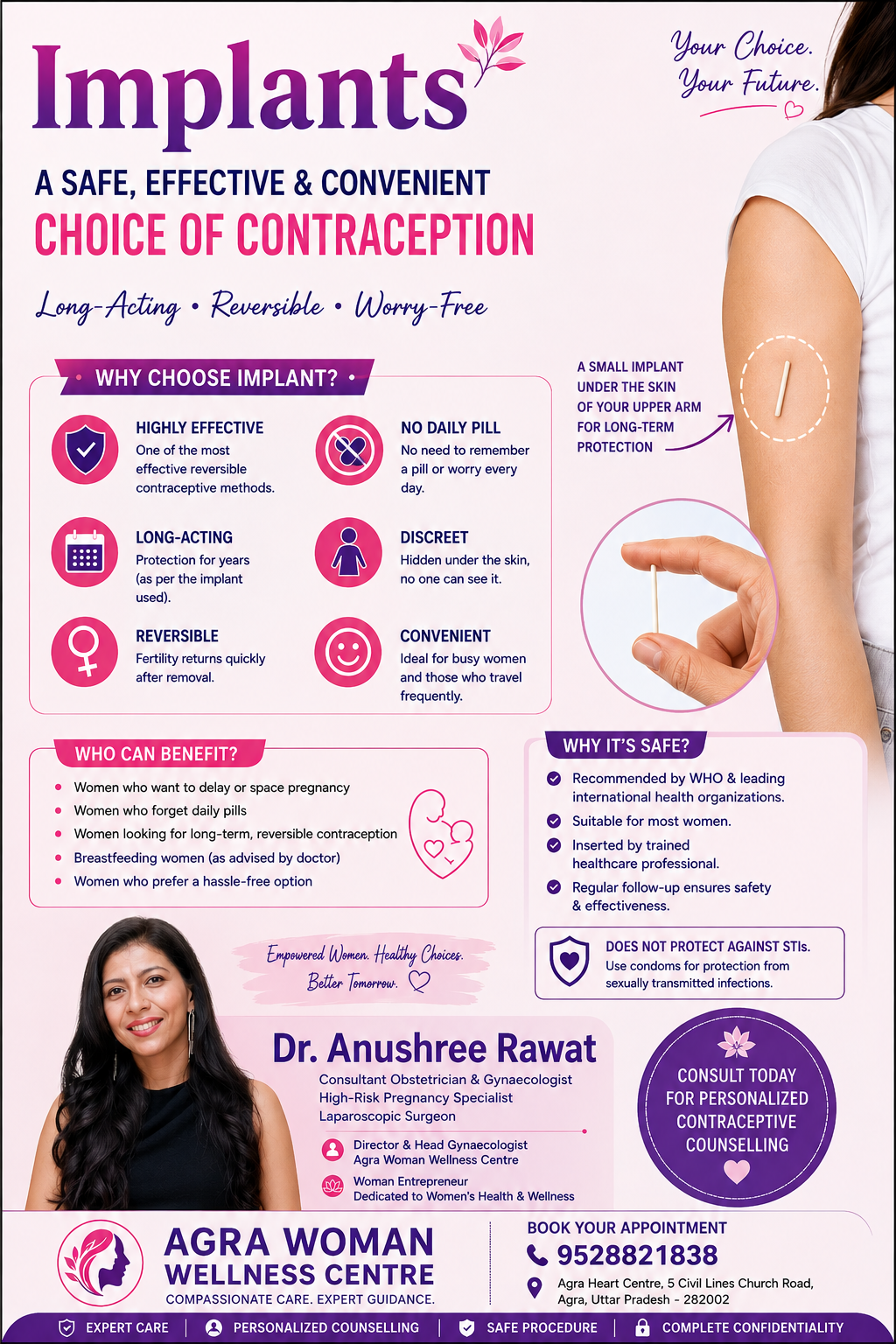
Contraceptive Implants: A Better, Safe and Convenient Choice for Long-Term Contraception
Contraceptive Implant in Agra | Long-Acting Reversible Contraception | Dr. Anushree Rawat | Agra Woman Wellness Centre
Choosing the right contraception is an important decision for every woman. Whether you want to delay your first pregnancy, space pregnancies, or postpone your next pregnancy for several years, contraception should be safe, effective, convenient and suited to your individual health needs.
One increasingly important option is the contraceptive implant, a long-acting reversible contraceptive (LARC) that provides reliable pregnancy prevention without requiring a woman to remember a pill every day or return regularly for injections.
If you are searching for a contraceptive implant in Agra, best contraception in Agra, long-term contraception for women, or want to know whether an implant is safe for you, consultation with an experienced gynecologist can help you make an informed decision.
At Agra Woman Wellness Centre, Dr. Anushree Rawat, Consultant Obstetrician & Gynecologist, High-Risk Pregnancy Specialist and Laparoscopic Surgeon, provides individualized counselling regarding contraception and family planning.
What Is a Contraceptive Implant?
A contraceptive implant is a small, flexible hormonal rod placed just underneath the skin of the upper arm by a trained healthcare professional.
It releases a progestin hormone gradually and works mainly by:
- Preventing or suppressing ovulation
- Thickening cervical mucus, making it difficult for sperm to enter the uterus
- Producing changes in the uterine lining
Depending on the specific implant used, contraceptive protection can last for several years. WHO describes implants as highly effective, long-acting and reversible contraception, with duration depending on the implant type.
Importantly, the exact duration depends on the specific implant product and its approved labeling.
Why Are More Women Choosing Contraceptive Implants?
For many women, the biggest advantage is simple:
You don't have to remember contraception every day.
Unlike contraceptive pills, which require regular daily use, an implant provides continuous contraception after insertion.
This makes it particularly useful for women who:
- Want to postpone pregnancy for several years
- Want to space pregnancies
- Forget daily contraceptive pills
- Prefer a private contraceptive method
- Want a highly effective reversible option
- Do not want frequent contraceptive injections
- Want fertility to return after discontinuation
WHO notes that implants require little action from the user once inserted and are among the highly effective long-acting reversible contraceptive options.
Is a Contraceptive Implant Safe?
For appropriately selected women, contraceptive implants are considered a safe and effective method of contraception.
However, "safe" does not mean that the same contraceptive is ideal for every woman.
Your gynecologist should consider factors such as:
- Age
- Medical history
- Current medications
- Previous pregnancy history
- Breastfeeding status
- Menstrual pattern
- Liver disease
- History of breast cancer
- Other medical conditions
- Your future pregnancy plans
The WHO Medical Eligibility Criteria for Contraceptive Use, 6th edition (2025) provides recommendations for assessing contraceptive safety according to individual health conditions and characteristics.
Therefore, contraceptive implants should be chosen after appropriate medical counselling rather than simply based on someone else's experience.
How Effective Is a Contraceptive Implant?
Contraceptive implants are among the most effective reversible contraceptive methods.
Their major advantage is that effectiveness does not depend on remembering a pill every day.
This is particularly important because real-life contraceptive effectiveness can be affected by missed pills, delayed injections or inconsistent use.
Once an implant is correctly inserted, it continuously releases the hormone without requiring daily action.
WHO classifies implants among highly effective, long-lasting contraceptive methods.
How Is the Implant Inserted?
Implant insertion is generally a short procedure performed by a trained healthcare provider.
The usual process involves:
1. Consultation
Your gynecologist discusses your medical history, menstrual cycle, pregnancy plans and contraceptive preferences.
2. Pregnancy assessment
The doctor confirms that you are not pregnant and determines the appropriate timing for insertion.
3. Local anaesthesia
The upper arm is cleaned and local anaesthesia is used to minimize discomfort.
4. Implant insertion
The small implant is placed just beneath the skin of the upper arm using an appropriate insertion device.
5. Aftercare
You receive instructions regarding the insertion site and when to seek medical advice.
WHO guidance emphasizes that implants should be inserted and removed by appropriately trained providers.
Does Implant Insertion Hurt?
Most women tolerate the procedure well.
Because local anaesthesia is used, significant pain during insertion is generally minimized.
You may experience:
- Mild tenderness
- Bruising
- Temporary swelling
- Mild discomfort around the insertion site
These symptoms usually settle with time.
If you experience increasing pain, significant swelling, redness, discharge or other concerning symptoms, contact your healthcare provider.
What Are the Benefits of Contraceptive Implants?
1. Long-acting protection
Depending on the product, an implant can provide contraception for several years.
2. Highly effective
Implants are among the most effective reversible contraceptive methods.
3. No daily pill
You don't have to remember contraception every morning.
4. Reversible
The implant can be removed whenever pregnancy is desired or if you decide to change your contraceptive method.
5. Fertility can return rapidly after removal
Pregnancy can occur soon after removal, so women who do not want pregnancy after removal should start another contraceptive method promptly.
6. Estrogen-free option
Implants are progestin-only methods, which may make them an option for some women who should avoid estrogen-containing contraception.
However, suitability must always be assessed individually.
7. Convenient for busy women
For women managing careers, children, household responsibilities and travel, an implant can eliminate the need for frequent contraceptive action.
What Are the Possible Side Effects?
One of the most important things to understand before choosing an implant is that changes in menstrual bleeding are common.
You may experience:
- Irregular bleeding
- Spotting
- Longer bleeding episodes
- Bleeding at unpredictable times
- Less frequent periods
- Absence of periods
These changes are usually not dangerous, although they can be inconvenient or bothersome for some women.
WHO guidance specifically notes that bleeding changes are common with implants and are generally not harmful.
Other possible symptoms can include:
- Headache
- Breast tenderness
- Acne
- Mood changes
- Changes in menstrual pattern
- Temporary discomfort at the insertion site
Your gynecologist can discuss whether symptoms are likely to be related to the implant and what treatment or alternative contraception may be appropriate.
Does the Implant Stop Periods?
It can, but not in every woman.
Some women experience lighter or less frequent periods, while others experience irregular spotting or bleeding.
Therefore, an implant should not be chosen with the expectation that periods will definitely stop.
Similarly, irregular bleeding does not automatically mean that the implant is unsafe or that something is wrong.
Can You Get Pregnant After Removing the Implant?
Yes.
The implant is a reversible contraceptive method.
Once the implant is removed, fertility can return quickly. WHO specifically describes implants as immediately reversible, with pregnancy possible soon after removal.
If you are planning pregnancy after removal, discuss preconception care and folic acid supplementation with your gynecologist.
Is the Implant Suitable for Breastfeeding Mothers?
Progestin-only implants can be used by many breastfeeding women, but the timing and individual suitability should be assessed by a healthcare professional.
WHO guidance recognizes implants as an option that can be used during breastfeeding.
If you have recently delivered a baby and are looking for postpartum contraception in Agra, discuss your options with your gynecologist before choosing a method.
Who May Benefit From a Contraceptive Implant?
An implant may be particularly useful for women who:
- Want reliable pregnancy prevention
- Want to space pregnancies
- Want contraception for several years
- Frequently forget contraceptive pills
- Prefer not to use an intrauterine device
- Want a reversible method
- Prefer a discreet method
- Want an estrogen-free contraceptive option
However, there is no single best contraceptive for every woman.
The "best" method is the one that is medically appropriate and fits your reproductive goals, lifestyle and preferences.
Who Should Not Automatically Choose an Implant?
Certain medical conditions or medications may affect whether a particular implant is appropriate.
Your gynecologist should evaluate you if you have:
- Certain liver conditions
- Current or previous breast cancer
- Unexplained vaginal bleeding
- Certain medication interactions
- Other significant medical conditions
This is why an online article should never replace an individual contraceptive consultation.
The latest WHO Medical Eligibility Criteria provides evidence-based guidance for choosing contraception according to individual medical circumstances.
Implant vs Contraceptive Pills
| Feature | Implant | Daily Pills |
|---|---|---|
| Daily action required | No | Yes |
| Long-term protection | Yes | No |
| User-dependent | Much less | More |
| Reversible | Yes | Yes |
| Menstrual changes | Possible | Possible |
| Requires healthcare provider | For insertion/removal | Usually not for daily use |
| Protection from STIs | No | No |
If protection against sexually transmitted infections is needed, condoms remain important, because contraceptive implants do not protect against STIs, including HIV.
Implant vs Copper-T / IUD
Both implants and IUDs are long-acting reversible contraceptive methods, but they work differently.
Implant
- Placed under the skin of the arm
- Hormonal
- Does not require placement inside the uterus
- Long-acting
- Reversible
Copper IUD
- Placed inside the uterus
- Non-hormonal
- Provides long-term contraception
- May increase menstrual bleeding and cramps in some women
The right choice depends on your menstrual pattern, medical history, reproductive plans and personal preference.
Is Contraceptive Implant Better Than Other Methods?
There is no universal "best contraception."
Instead, think of contraception as a personalized menu rather than a one-size-fits-all prescription.
For some women, an implant may be an excellent choice.
For others, a hormonal IUD, copper IUD, pill, injectable, condom or permanent contraception may be more appropriate.
The goal is to select the safest and most suitable method for your individual circumstances.
Common Myths About Contraceptive Implants
Myth 1: "The implant causes permanent infertility."
Fact: The implant is reversible. Fertility can return rapidly after removal.
Myth 2: "The implant has to be inside the uterus."
Fact: The contraceptive implant is placed under the skin of the upper arm.
Myth 3: "Irregular bleeding means the implant is dangerous."
Fact: Changes in bleeding patterns are common with implants and are generally not harmful, although persistent or troublesome bleeding deserves medical evaluation.
Myth 4: "The implant protects against infections."
Fact: It prevents pregnancy but does not protect against sexually transmitted infections. Condoms are required for STI protection.
Myth 5: "You cannot become pregnant after removing it."
Fact: It is reversible and pregnancy can occur soon after removal.
When Should You See a Gynecologist About Contraceptive Implants?
Consider a consultation if you are:
- Planning to delay pregnancy
- Looking for contraception after childbirth
- Looking for postpartum contraception
- Planning to space your next pregnancy
- Forgetting contraceptive pills
- Experiencing side effects from your current contraceptive
- Looking for a long-term reversible contraceptive
- Considering switching from another contraceptive method
- Unsure which contraception is best for you
A personalized consultation allows your gynecologist to discuss the advantages, limitations, alternatives and possible side effects before you make your decision.
Why Choose Dr. Anushree Rawat for Contraceptive Counselling in Agra?
Dr. Anushree Rawat is a Consultant Obstetrician & Gynecologist, High-Risk Pregnancy Specialist and Laparoscopic Surgeon associated with Agra Woman Wellness Centre.
Contraceptive counselling should go beyond simply prescribing a method. It should involve understanding a woman's:
- Current health
- Menstrual history
- Previous pregnancies
- Future fertility plans
- Breastfeeding status
- Lifestyle
- Personal preferences
- Concerns about side effects
The aim is to help every woman make an informed, safe and personalized contraceptive choice.
Contraceptive Implant in Agra: Expert Family Planning Consultation
If you are searching online for:
"Contraceptive implant in Agra"
"Best contraception doctor in Agra"
"Contraception specialist in Agra"
"Long-term contraception in Agra"
"Implant contraception in Agra"
"Safe contraception for women in Agra"
"Birth control implant in Agra"
"Best gynecologist for contraception in Agra"
"Family planning doctor in Agra"
"Contraceptive implant near me"
you should consider discussing all available options with an experienced gynecologist rather than choosing a method solely from internet information.
Women can seek professional contraceptive counselling based on their individual requirements.
Frequently Asked Questions About Contraceptive Implants
1. What is the contraceptive implant?
It is a small flexible hormonal implant placed beneath the skin of the upper arm that provides long-acting reversible contraception.
2. How long does a contraceptive implant last?
Duration depends on the specific implant. Some implants provide protection for approximately 3 years, while other products are approved for longer durations. Your doctor should explain the exact duration of the product being used.
3. Is the implant safe?
For appropriately selected women, implants are considered safe and highly effective. Individual medical assessment is important.
4. Can unmarried women use contraceptive implants?
Contraception is a personal healthcare decision. Medical suitability should be assessed individually, regardless of marital status.
5. Can teenagers use contraceptive implants?
Implants may be appropriate for adolescents in many circumstances, but individual medical assessment and counselling are important.
6. Can I use an implant while breastfeeding?
Many breastfeeding women can use progestin-only implants. Your doctor can advise you about appropriate timing and suitability.
7. Does an implant protect against STIs?
No. Condoms are needed for protection against sexually transmitted infections.
8. Can I remove the implant before its full duration?
Yes. It can be removed by a trained healthcare provider if you want pregnancy, want to change methods or for another medical reason.
9. Will my periods become irregular?
They may. Changes in menstrual bleeding are one of the most common effects of contraceptive implants.
10. Can I become pregnant after implant removal?
Yes. Fertility can return rapidly after removal.
Final Takeaway
A contraceptive implant can be an excellent long-term, reversible and highly effective option for women who want reliable pregnancy prevention without daily pills or frequent injections.
But contraception should never be selected on effectiveness alone.
Your age, health, menstrual pattern, breastfeeding status, medications, pregnancy plans and personal preferences all matter.
If you are considering a contraceptive implant in Agra, consult Dr. Anushree Rawat at Agra Woman Wellness Centre for individualized contraceptive counselling and to understand whether an implant is the right choice for you.
Your contraception should fit your life, not make your life revolve around contraception.
Book a Contraceptive Consultation
Dr. Anushree Rawat
Consultant Obstetrician & Gynecologist | High-Risk Pregnancy Specialist | Laparoscopic Surgeon
Agra Woman Wellness Centre
Agra, Uttar Pradesh
For appointments: 9528821838
Medical disclaimer: This article is intended for general educational information and does not replace an individual consultation, examination or prescription from a qualified healthcare professional.
Evidence base: WHO's current contraception guidance and its 2025 Medical Eligibility Criteria and Selected Practice Recommendations should be used when assessing individual eligibility and contraceptive choice.