
Who Should Consider Egg Freezing for Future Pregnancy
Women today actively shape their reproductive choices in response to the demands of modern society. The egg freezing process has become one of the most discussed fertility treatments worldwide because of its ability to help women who need to postpone motherhood due to their career ambitions or medical needs or later marriage plans or their desire to have additional time.
Medically known as oocyte cryopreservation, egg freezing allows women to preserve healthy eggs at a younger age and use them later when they are ready for pregnancy. Modern fertility science, together with enhanced oocyte cryopreservation success rates, has made this procedure more secure and efficient and accessible than at any previous time in history.
But before making a decision, it is important to understand the complete process, costs, success rates, benefits, and possible risks involved.
What Is Egg Freezing and How Does It Work?
Egg freezing, also called oocyte cryopreservation, is a fertility preservation technique where a woman’s eggs are collected, frozen, and stored for future pregnancy use.
The main benefit of this procedure preserves the vitality of younger eggs. The procedure allows you to freeze your eggs, which can later be used for IVF after thawing and fertilization to be implanted into your uterus.
The entire process of freezing your eggs provides women with additional options for reproduction while decreasing the impact of aging on their ability to conceive.
Why Women Choose Egg Freezing
Today, women are choosing the egg freezing process for multiple reasons.
1. Career & Personal Goals
Many women want to focus on education, business, career growth, or finding the right partner before starting a family.
2. Medical Reasons
Women facing chemotherapy, radiation, endometriosis, PCOS, autoimmune disorders, or surgeries often consider fertility preservation options to protect future fertility.
3. Family History
If early menopause runs in the family, doctors may recommend the oocyte cryopreservation process earlier.
4. Delayed Marriage or Motherhood
Modern lifestyles have changed relationship timelines, making oocyte cryopreservation a practical option for many women.
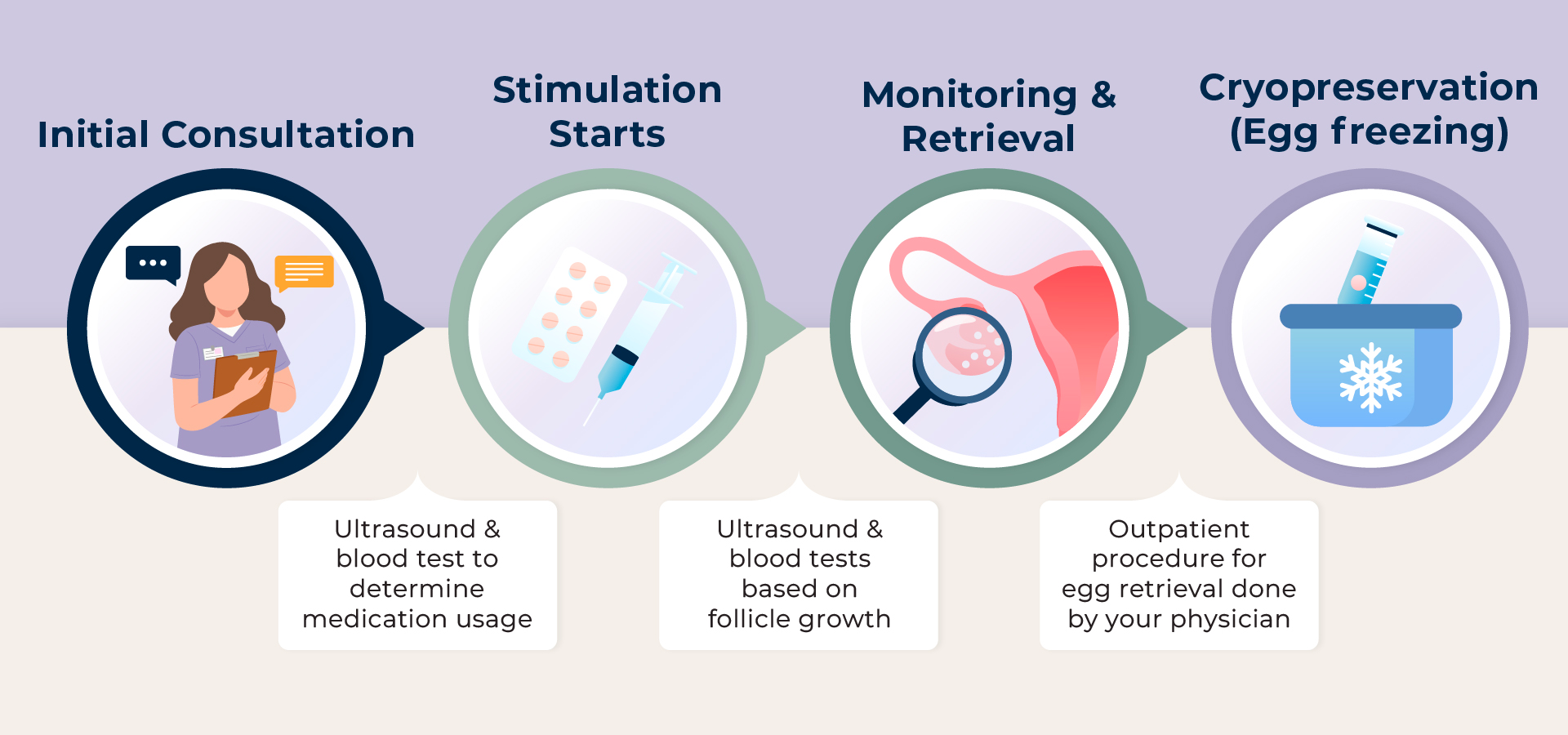
Egg Freezing Process Step by Step
Understanding the complete egg freezing process helps reduce anxiety and prepares you mentally and physically.
Step 1: Fertility Evaluation
These tests determine your ovarian reserve and egg quality. Before starting the oocyte cryopreservation process, your fertility specialist performs:
- AMH blood test
- Ultrasound scan
- Hormonal evaluation
- Medical history review
Step 2: Ovarian Stimulation
The current stage is a crucial step in the egg freezing procedure because it determines both the quantity and quality of eggs, which will impact future success in achieving pregnancy.
The procedure requires hormonal injections, which are administered for approximately 10 to 12 days to stimulate ovarian function and produce several mature eggs.
During this stage:
- Regular ultrasounds are done
- Blood tests monitor hormone levels
- Doctors track follicle growth
Step 3: Egg Retrieval Procedure
The mature eggs are collected from the ovaries carefully. Once the eggs mature, a trigger injection is given, followed by egg retrieval after approximately 36 hours.
The procedure:
- Takes around 20–30 minutes
- Is done under mild anaesthesia
- Uses ultrasound guidance
Step 4: Freezing the Eggs
The collected eggs are frozen using advanced vitrification technology.
Modern oocyte cryopreservation techniques freeze eggs rapidly, reducing ice crystal formation and improving survival rates during thawing.
Step 5: Storage
Frozen eggs are safely stored in specialized fertility laboratories for years.
Women can later use these eggs whenever they decide to plan pregnancy.
Oocyte Cryopreservation Success Rates
One of the most important concerns women have is about oocyte cryopreservation success rates.
Women who freeze eggs earlier usually have significantly better oocyte cryopreservation success rates.
Success depends mainly on:
- Age at freezing
- Number of eggs frozen
- Egg quality
- Overall reproductive health
Average Oocyte Cryopreservation Success Rates
|
Age at Freezing |
Estimated Success Chance |
|
Under 35 |
70–90% |
|
35–37 |
50–70% |
|
Above 38 |
Lower success rates |
Egg Freezing Cost in India
The egg freezing cost varies depending on city, clinic reputation, medications, and storage duration.
Average Egg Freezing Cost
|
Treatment Component |
Estimated Cost |
|
Hormonal Medications |
鈧�80,000 – 鈧�1,50,000 |
|
Egg Retrieval Procedure |
鈧�70,000 – 鈧�1,50,000 |
|
Freezing & First-Year Storage |
鈧�50,000 – 鈧�1,00,000 |
|
Annual Storage Fee |
鈧�20,000 – 鈧�50,000 |
Overall, the total egg freezing cost in India may range between 鈧�1.5 Lakhs and 鈧�3.5 Lakhs per cycle.
The final egg freezing cost can increase if multiple cycles are required to collect more eggs.
Egg Freezing: Benefits and Risks
Before making a decision, understanding the complete egg freezing benefits and risks picture is essential.
Egg Freezing Benefits
1. Fertility Preservation
One of the biggest advantages of fertility preservation options is preserving younger eggs for future pregnancy.
2. Reduced Biological Clock Pressure
Women gain flexibility regarding career, relationships, and family planning.
3. Better Future Pregnancy Chances
Freezing younger eggs improves future IVF outcomes.
4. Peace of Mind
Many women feel emotionally relieved after completing the egg freezing process.
Egg Freezing Risks
Like every medical procedure, the egg freezing benefits risks should be carefully discussed with a fertility specialist.
Egg freezing improves possibilities, but it does not guarantee future childbirth.
Possible risks include the following:
- Hormonal side effects
- Bloating and mood swings
- Mild discomfort
- Ovarian Hyperstimulation Syndrome (OHSS) in rare cases
- No guaranteed pregnancy
Is egg freezing actually worth it?
The egg freezing process gives women confidence and flexible options while providing them with reproductive security.
The doctors need to conduct personalized assessments before recommending any medical procedure to patients. This is one of the most common questions women ask.
The answer depends on:
- Your age
- Future pregnancy plans
- Medical condition
- Financial comfort
- Fertility health
What is the Best Age for Egg Freezing?
Women above 37 can still undergo the procedure, but the number and quality of eggs may be reduced.
Most fertility experts suggest:
- Late 20s to early 30s is the ideal time
- Before 35 for the best egg quality
Fertility Preservation Options Besides Egg Freezing
Among all available fertility preservation options, egg freezing remains one of the most preferred choices for women wanting reproductive independence.
There are several fertility preservation options available today apart from egg freezing.
These include:
- Embryo freezing
- Ovarian tissue freezing
- Sperm freezing
- IVF embryo preservation
Emotional & Mental Considerations
The freezing of your eggs process is not just physical; it can also be emotional. Counselling and proper fertility education help in making informed choices.
Some women feel:
- Empowered
- Relieved
- Anxious
- Confused about future decisions
Final Thoughts: Egg-Freezing Process
The current procedures for egg freezing have created a new way for women to handle their fertility planning. The advancements in oocyte cryopreservation technology, together with its improved success rates, give women today more control over their future reproductive choices than at any previous time.
The best decision is always an informed one made with guidance from a qualified fertility specialist.
However, it is important to remember:
- Egg freezing is not guaranteed insurance
- Earlier freezing generally gives better outcomes
- Costs and emotional factors should be considered carefully
FAQs About Egg Freezing
1. What is the egg-freezing process?
The egg freezing process involves hormonal stimulation, egg retrieval, freezing, and long-term storage for future pregnancy use.
2. What is the process of freezing eggs?
The process of freezing eggs includes ovarian stimulation, egg collection, vitrification freezing, and fertility preservation storage.
3. What is the process of egg freezing?
The process of egg freezing starts with fertility testing followed by injections, egg retrieval, and freezing through advanced vitrification methods.
4. What is the process for freezing your eggs?
The process for freezing your eggs generally takes around 2–3 weeks from testing to egg retrieval and freezing.
5. Is egg freezing actually worth it?
For many women, egg freezing offers reproductive flexibility and peace of mind, especially when done at a younger age.
6. Can you get Botox before egg freezing?
Doctors usually recommend discussing Botox or cosmetic procedures with your fertility specialist before starting hormonal medications.
7. Is 37 a good age to freeze eggs?
Yes, egg freezing is still possible at 37, but success rates are generally lower compared to freezing before 35.
8. What are oocyte cryopreservation success rates?
Oocyte cryopreservation success rates depend mainly on age, egg quality, and the number of eggs frozen.
9. What is oocyte cryopreservation?
Oocyte cryopreservation is the medical term for freezing a woman’s eggs for future fertility use.
10. What is the cost of egg freezing in India?
The average egg-freezing cost in India ranges between 鈧�1.5 Lakhs and 鈧�3.5 Lakhs per cycle.
11. What are the egg-freezing benefits and risks?
Benefits include fertility preservation and flexibility, while risks may include hormonal side effects and no guaranteed pregnancy.
12. At what stage do most IVF failures occur?
IVF may fail during fertilization, embryo development, or implantation or due to poor egg quality and age-related factors.