
Trying to Conceive But Not Getting Pregnant? The Fallopian Tubes Could Be the Missing Link
If you and your partner have been trying for pregnancy without success, one of the most important investigations is a tubal patency test. Many couples focus only on ovulation or sperm count, but healthy and open fallopian tubes are equally essential for natural conception.
At Agra Woman Wellness Centre, Dr. Anushree Rawat, one of the best gynaecologists in Agra, provides comprehensive infertility evaluation for both partners to identify the exact cause of delayed conception and guide the most suitable fertility treatment.
Tubal factors contribute to a substantial proportion of female infertility, making tubal assessment an important part of the infertility work-up. Current guidelines recommend tests such as HSG (Hysterosalpingography) or HyCoSy (Hysterosalpingo Contrast Sonography) for evaluating tubal patency.
What Is a Tubal Patency Test?
A tubal patency test checks whether the fallopian tubes are open or blocked.
If either or both tubes are blocked, sperm and egg cannot meet naturally.
During natural conception:
- The ovary releases an egg.
- The sperm travels through the uterus into the fallopian tube.
- Fertilization occurs inside the tube.
- The embryo then moves into the uterus for implantation.
Who Should Undergo a Tubal Patency Test?
Dr. Anushree Rawat may recommend this infertility test if you have the following:
- Been trying for pregnancy for over 12 months (or 6 months if age is above 35 years)
- A history of pelvic infection
- A previous ectopic pregnancy
- Endometriosis
- Tuberculosis affecting the pelvis
- Previous abdominal or pelvic surgery
- Recurrent infertility
- A plan to undergo IUI treatment
- Unexplained infertility
Types of Tubal Patency Tests
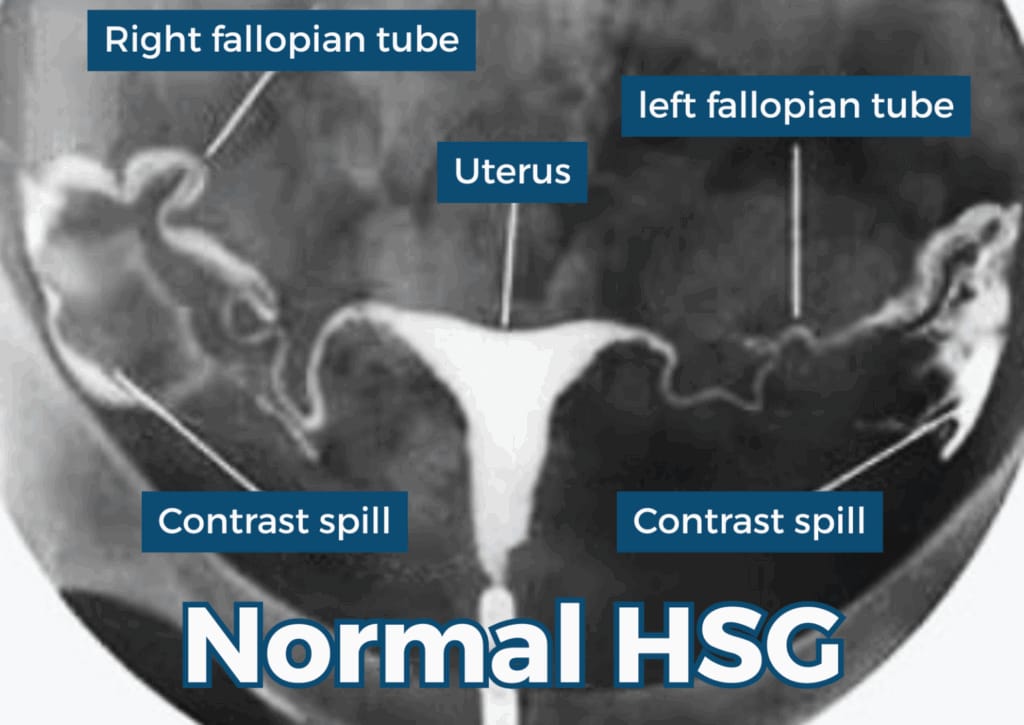
1. HSG (Hysterosalpingography)
The most commonly performed tubal patency test. A contrast dye is injected through the cervix while X-ray images are taken. It evaluates:
- Uterine cavity
- Shape of uterus
- Fallopian tube patency
- Tubal blockage
2. HyCoSy (Hysterosalpingo Contrast Sonography)
HyCoSy is increasingly used as a first-line option in many fertility centers.
A modern ultrasound-based test using contrast media instead of X-rays. Advantages include:
- No radiation
- Better patient comfort
- Real-time ultrasound assessment
- Evaluation of uterus and tubes together
3. Laparoscopy with Dye Test
It also allows treatment during the same procedure when appropriate. This is considered the gold standard when surgery is already indicated. It helps diagnose:
- Endometriosis
- Pelvic adhesions
- Tubal blockage
- Pelvic pathology
When Is the HSG Test Done?
Usually between Day 6 and Day 10 of the menstrual cycle:
- After menstrual bleeding stops
- Before ovulation
- When pregnancy has been ruled out
Is the HSG Test Painful?
The discomfort usually settles quickly, and your doctor may advise taking a pain reliever before the procedure. Most women experience:
- Mild cramping
- Period-like pain
- Pressure lasting only a few minutes
Can an HSG Improve Fertility?
Some studies suggest that pregnancy rates may be slightly higher for a few months after HSG, particularly when oil-based contrast is used in selected patients. However, HSG should primarily be viewed as a diagnostic test rather than a fertility treatment.
Other Essential Infertility Tests for Couples
Infertility evaluation should always involve both partners.
Female Fertility Tests
- Ovulation assessment
- AMH test
- Hormonal profile (FSH, LH, TSH, Prolactin)
- Pelvic ultrasound
- Tubal patency test
- Hysteroscopy (when indicated)
Male Fertility Tests
- Semen analysis
- Sperm count
- Sperm motility
- Sperm morphology
- Additional hormonal or genetic tests when required
Causes of Blocked Fallopian Tubes
- Pelvic inflammatory disease (PID)
- Genital tuberculosis
- Endometriosis
- Previous pelvic surgery
- Fibroids
- Congenital abnormalities
- Previous ectopic pregnancy
Treatment After Tubal Patency Test
Treatment depends on the results. Your fertility specialist may advise the following:
- Ovulation induction
- Timed intercourse
- IUI
- Laparoscopic surgery
- Tubal recanalization (selected cases)
- IVF, if both tubes are severely damaged or blocked
Why Choose Dr. Anushree Rawat for Infertility Treatment in Agra?
Dr. Anushree Rawat provides evidence-based fertility care with individualized evaluation and treatment plans at Agra Woman Wellness Centre.
If you are searching for:
- Best Gynaecologist in Agra
- Infertility Specialist in Agra
- HSG Test in Agra
- Tubal Patency Test in Agra
- Fertility Doctor in Agra
- Best Pregnancy Doctor in Agra
- Female Infertility Treatment in Agra
- Couple Infertility Evaluation in Agra
FAQs About Tubal Patency Test
Q1. How long does an HSG test take?
Usually 10 to 20 minutes.
Q2. Can I get pregnant after an HSG?
Yes. Some couples conceive naturally in the months following the test, although the test itself is primarily diagnostic.
Q3. Is fasting required before HSG?
No. Most women do not need to fast unless instructed otherwise.
Q4. Can blocked tubes be treated?
Depending on the cause, treatment may include surgery, tubal recanalization, or IVF.
Q5. Should the husband also undergo testing?
Yes. Around one-third of infertility cases involve male factors, so semen analysis is an essential part of the evaluation.